
Not the Tallest, Just the Most Powerful
It's the amount of water that matters
Niagara Falls is not the tallest waterfall in the world. The Horseshoe Falls drop about 57 metres — roughly the height of a 19-storey building. Many waterfalls are taller, and most people have never heard of them.
Angel Falls in Venezuela drops 979 metres — about 17 times the height of Niagara. Tugela Falls in South Africa drops 948 metres. Even Yosemite Falls in California reaches 739 metres. All of them are taller. None of them comes close to Niagara in what really matters here: the amount of water in motion.
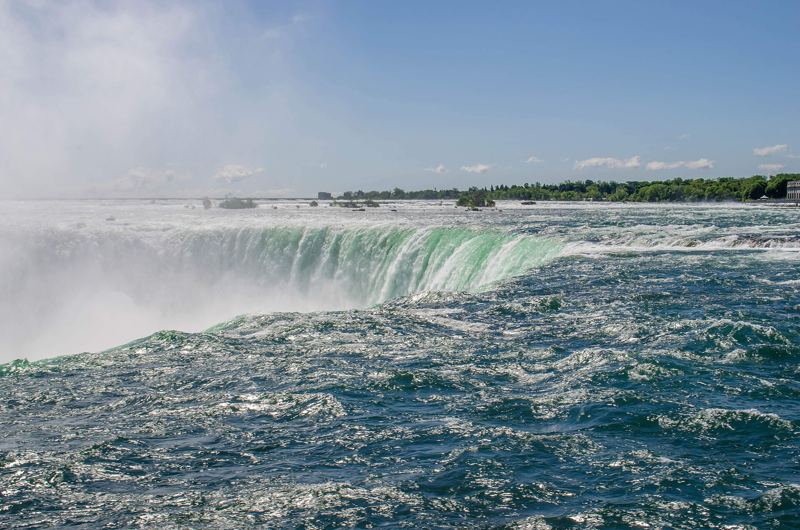
In the daytime during tourist season, at least 2,800 cubic metres of water — about 2.8 million litres — must go over the Falls every second, and most of it goes over the Horseshoe Falls.
That volume is why the sound carries so far. It's why you can feel the ground vibrate under your feet. It's why the mist rises high enough to be seen from far away, and why the gorge below the Falls is as deep and wide as it is. Height makes a pretty photograph. Volume reshapes the landscape.
Even after more than a century of diverting water for electricity — up to three-quarters of the flow on a winter night — what still goes over the edge ranks Niagara among the highest-flow waterfalls on Earth.
Niagara isn't famous for how far the water falls. It's famous for how much falls at once, and for what that much water, moving that fast, does to everything around it.
This sign stands at Table Rock lookout. See it on the map
Next sign 6The Mist Zone Railing north of Table RockPhoto credits
- Ethan Sahagun, CC BY-SA 3.0, via Wikimedia Commons
